Why Rugby Shirts Have a Collar—and What Its Changing Shape Says
Why rugby shirts have a collar becomes clearer when you read its shape, fabric, and fastening together, without mistaking a design clue for proof of age.
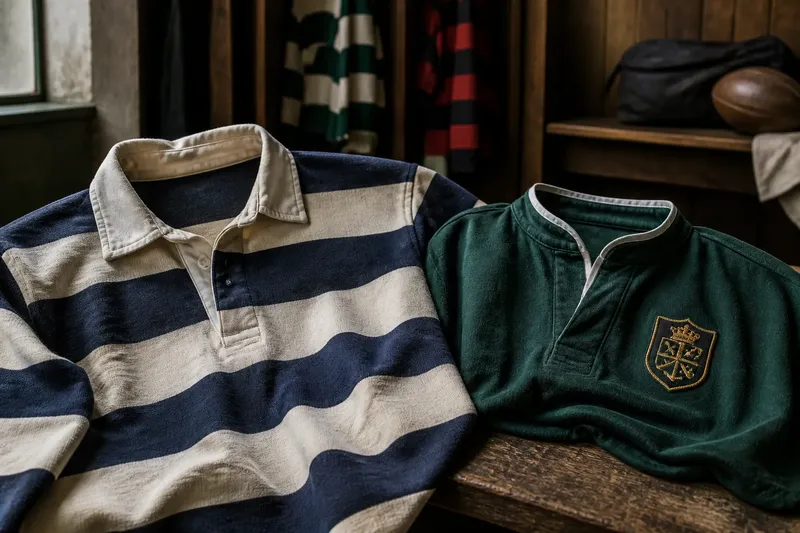
A striped rugby shirt with a soft fold-over collar can look halfway between everyday clothing and sporting kit. Why rugby shirts have a collar has no single settled answer: the feature connects the shirt to familiar dress, while its shape and construction vary across garments and eras.
Look closely at a stiff point, a short band, a button placket, or an open neckline, and you can describe what is there without assuming when the shirt was made or how it was used. The collar is one clue among many, not a reliable timeline by itself.
What does a collar add to a rugby shirt?
A fold-over collar gives a shirt an outline familiar from everyday clothing. Paired with a buttoned placket, it frames the neck and makes the upper front resemble a conventional shirt. That visual association can coexist with the bold stripes, robust-looking fabric, and club markings that identify the garment with rugby.
There is no need to assign every collar the same purpose. A designer might use a traditional shape, a player might appreciate how a particular neckline feels, and a club might favor a recognizable appearance. Without information about a specific shirt, those remain possibilities rather than explanations of its history.
How do rugby shirt collars vary?
Rugby shirts can have pointed fold-over collars, softer rounded shapes, narrow bands, short flaps, or no conventional collar. Some have a button placket; others have a different opening or none. These differences do not form a universal sequence from old to new. A contemporary design can borrow an older-looking collar, while a shirt with a pared-back neckline cannot be dated from that feature alone.
Consider the full garment. Fabric weight, cut, seams, closure, label, and markings all contribute to how a shirt looks and what can responsibly be said about it. A collar is a useful design detail, but it cannot establish that a shirt was made for match play.
What should you record when describing a collar?
For a club display, family collection, or secondhand listing, separate visible observations from guesses. Check each feature and let the observation guide what you say next:
- Shape: If the edges form points, describe a pointed fold-over collar; if they are rounded or absent, describe that shape instead of calling it pointed.
- Structure: If the collar holds a crisp outline, record it as structured; if it bends or lies flat, describe it as soft or flexible.
- Material: If the collar visibly differs from the body fabric, note the contrast; if it appears to match, record that and avoid guessing at fiber content.
- Attachment: If a seam clearly joins a separate collar piece to the neckline, describe it as a separate piece; if the construction is unclear, say it is unclear rather than infer how it was made.
- Closure: If buttons and a placket are present, record their placement; if the neck is open or uses another closure, describe that instead.
- Wear and repair: If fading, stretched stitching, or a repair is visible, document its location; if none is visible, do not infer that the shirt is unworn.
- Context: If a label, badge, or accompanying record is present, note what it says and where it appears; if no supporting context exists, leave the date, club, or use unassigned.
These choices make a description more useful without turning an impression into provenance. A collar may suggest a design tradition, but supporting records and other garment details are needed for stronger claims.
What do people ask about rugby shirt collars?
Does every rugby shirt need a fold-over collar?
No. Rugby shirts can have small collars, bands, or collarless necklines. The fold-over shape is a familiar option, not a fixed requirement.
Does a small collar mean a shirt is newer?
No, not by itself. Designs can reuse older shapes, so consider the fabric, construction, label, and documented context together.
Why can a rugby collar resemble a polo collar?
Both garments can have a folded collar and a short opening, which makes their outlines similar. Fabric, cut, markings, and context offer more clues than the collar alone.
Can a collar identify a club or season?
Usually not on its own. A badge, label, sponsor mark, or accompanying record may provide context, but each clue still needs to be interpreted carefully.
How can you compare two rugby shirt collars?
Say you find two shirts in a club cupboard. The first has broad stripes, a soft pointed collar, a short button placket, and a label with no readable date. The second has a narrow band neckline, a different fabric, and a visible club badge. First, record those observations separately; next, photograph each neckline and its nearby details; then compare shape, structure, fabric, closure, and markings. The resulting description can say that the shirts use different neckline designs and that the second bears a club badge. It cannot, from those details alone, establish which is older or whether either was worn in a match.
This approach keeps a comparison grounded in what is visible. If a dated club record later turns up, it can be added as separate evidence rather than treated as something the collar already proved.
Why does the collar still matter?
The collar helps a rugby shirt hold two visual roles at once: it can recall familiar everyday dress while the fabric, stripes, and construction point toward sport. Some designs keep a pronounced fold, while others use a smaller or softer reference; the shirt can change without the collar disappearing.
When you ask why rugby shirts have a collar, start with the particular garment rather than a single origin story. Describe its shape, material, fastening, and condition, then add only the context supported by labels or records. That careful account makes the collar’s design meaning clearer—and leaves room for what the shirt cannot tell you.