The Rugby Club Tie as a Keepsake, Not Just a Dress Code
A rugby club tie can mark affiliation, carry a personal memory, and become a keepsake without implying anything about who owns or wears one.
A rugby club tie can begin as a visible sign of affiliation and end up holding a private memory of a particular team, place, or person. The rugby club tie’s social meaning depends on context: one wearer may use it to represent a club at an event, while another keeps it in a drawer as a reminder of a season or friendship.
What does a rugby club tie say about its wearer?
It may say that the wearer belongs to a club, is attending on its behalf, or has a connection to its people. But a tie alone cannot tell you the exact nature of that connection. It might have been issued to a player, given to a volunteer, bought by a supporter, or passed along by a relative.
The emblem makes an affiliation legible. Club colors, a crest, or a woven name can turn an ordinary accessory into a small piece of public representation. At a dinner, awards night, or visit to another club, the tie can help signal that the wearer is present in a club capacity. In a different setting, it may simply be a familiar garment the owner likes.
That distinction matters. People often read clothing as evidence of status, but ownership and use do not establish a person’s role, history, or authority. A tie may be borrowed for an occasion; a former player may never wear one; a supporter may treasure one without having held an official position. Ask about its story rather than assigning one.
How does a club tie become a keepsake?
A club tie becomes a keepsake when its associations outlast its practical use. The object carries more than its fabric and pattern: it can bring to mind a first season, a coach, a team trip, a family member, or a room where the club gathered. That meaning is personal, even when the design is shared by many people.
Often, the shift is gradual. A tie once worn regularly may be set aside when its owner changes roles or stops attending events. Later, finding it among other clothes can make a particular memory vivid. The tie does not need to be rare or old to matter; its value may come from who gave it or what the owner connects it with.
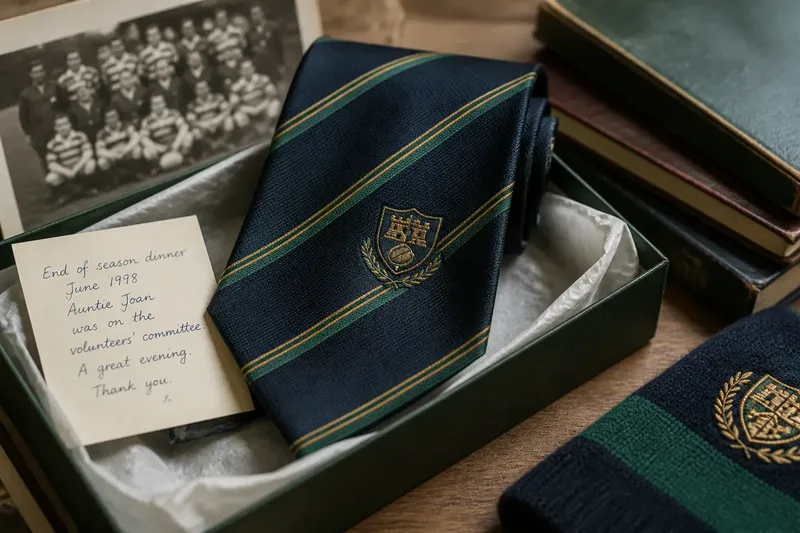
Say a supporter receives a tie from an aunt who volunteered at the club and wears it to one end-of-season dinner. After the aunt moves away, the supporter stores it with a handwritten note about that evening. The observable change is simple: the tie is no longer chosen mainly to dress for an event, but kept because it helps recall a relationship and a shared club occasion.
Who owns or wears a club tie?
There is no single type of person who owns or wears one. Players, coaches, committee members, supporters, former members, family, and guests may all have a tie, for different reasons. Some clubs offer ties as part of formal kit; others sell them, present them as gifts, or make them available for particular events.
Access and custom vary from club to club. A club may treat its tie as formal representation, while another sees it as merchandise or a personal keepsake. Even within one club, an individual may own several ties without wearing any, or borrow one for a ceremony. The object’s presence does not settle questions of membership or seniority.
If you are trying to identify a tie’s owner or history, begin with what can be seen: the crest, colors, woven wording, and any label or note stored with it. Those clues can narrow the possibilities, but they do not replace a conversation with the person or family connected to it. Avoid presenting a guess as a settled account.
What details help identify a tie’s club and period?
The most useful clues are the emblem and its wording, the colors and stripe arrangement, the tie’s reverse, and any attached label. A crest may include a place name or initials, while a woven inscription can name a club or event. If the tie came with a box, card, or photograph, keep those items together; their association may clarify its context.
Look carefully rather than relying on color alone. Similar palettes can appear across clubs, and colors may shift in photographs or under different light. A crest can also be difficult to read if the fabric has faded. Note uncertainty plainly: “possibly the junior team” is more accurate than turning a plausible interpretation into fact.
For a family record or club display, write down the source of the information alongside the description. A short note such as “identified by the original owner” helps later readers distinguish a remembered detail from a visual inference. If nobody knows the exact year, a broad description is still useful.
How should a meaningful tie be stored or displayed?
Store a tie so its fabric is not needlessly strained or exposed. A clean, dry drawer or archival box can keep it out of direct light and away from damp. If you display it, choose a spot where sunlight, handling, and dust are limited; a rotating display can reduce prolonged exposure while keeping the object visible.
For a tie that still gets worn, avoid forcing it into a tight knot or leaving it knotted for long periods. Let it rest flat or loosely rolled after use, and follow any care label or maker’s guidance for cleaning. The fiber and construction matter, so a delicate or stained tie may call for advice from a textile conservator rather than an improvised cleaning method.
Keep the story with the object. A small paper note in the storage box can record who owned it, who gave it, and what is known about its use. This need not be elaborate; a few clear sentences can preserve context without writing a grand history the evidence cannot support.
What questions do people ask about rugby club ties?
Does wearing a club tie prove someone is a member?
No. A tie can be borrowed, gifted, purchased, or worn as a sign of support, so it does not prove a person’s membership or role. The wearer’s connection is best understood through their own account and the club’s customs.
Can a supporter keep a club tie as a souvenir?
Yes, if the tie was given, purchased, or otherwise acquired with permission. A supporter may value it for its design or its connection to a club occasion, without claiming an official position.
Should an old club tie be worn or preserved?
That depends on its condition and what matters most to its owner. A sturdy tie may be suitable for occasional wear, while a fragile or especially meaningful one may be better stored and represented with a photograph.
How can I find out which club a tie belonged to?
Check the crest, woven wording, labels, and any papers or photographs kept with it, then ask people who may recognize the design. If the evidence remains incomplete, record the identification as uncertain rather than guessing.
When does the tie’s meaning change?
The tie’s meaning changes when its use or audience changes. On a club night, it may work as a shared sign that connects people to an institution. At home, the same tie can become a reminder of one person, one gift, or one chapter of club life. Its public emblem stays visible, but the owner’s private associations gather around it.
That layered meaning is why a club tie deserves more than a simple label such as “uniform” or “souvenir.” A rugby club tie can represent belonging without proving who belongs, and it can become a keepsake without being worn at all. If you preserve one, keep the object and its known story together; that small act makes the memory easier to understand for whoever encounters it next.